
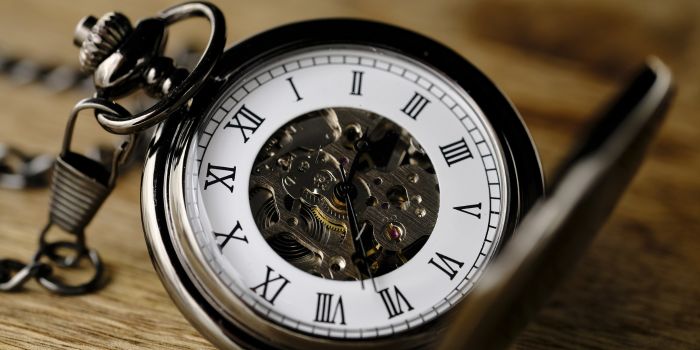
First manufactured in the 16th century, pocket watches used to look awkward. These were then worn as a necklace. But later (about a hundred years), wealthy people carried them in a pocket.
Traditionally these were made from expensive metals like gold. The man with one would therefore symbolize his richness in that era.
Later the cost of a pocket watch will generally depend on the material it is made of. If it’s a vintage piece made of expensive metal it may cost anywhere from $200 to $5,000. Today’s watches with cheap materials may however cost as low as $15 to $25.
Vintage Pocket Watch Maintenance
We may earn a small commission if you click and shop from the links on this page.
We know vintage pocket watches are rare treasures. If you have one, you always want to cherish it as a timeless piece of history that combines elegance with functionality.
But are you aware of the right procedure to clean your antique pocket watch that will help keep it safe and in working condition for a longer period?
Well, cleaning an expensive pocket watch, especially if it is an antique one, involves quite a bit of labor and patience. Especially when disassembling the mechanism inside the watch, you need to be very careful. Then cleaning and drying all the parts properly is a challenging job.
If you are not an expert or a passionate DIY’er who has the patience to complete the work in a do-it-yourself way, you should never try cleaning the watch yourself.
Instead, take it to a professional watchmaker or a watch repair shop where you can get it serviced at a cost.
However, for those who are passionate about do-it-yourself techniques, here we discuss the procedure of cleaning the pocket watch at home itself.
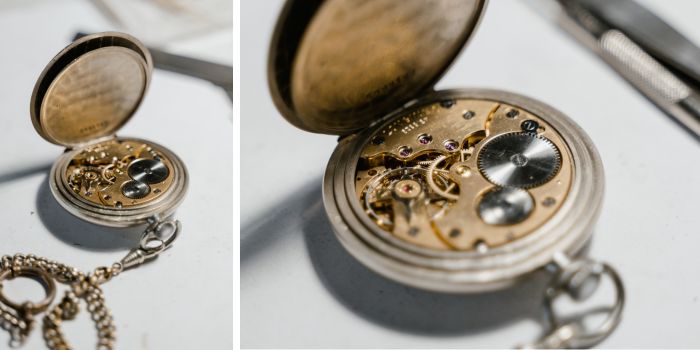
Steps to Cleaning and Oiling a Pocket Watch
Cleaning your pocket watch isn’t a tough process if you know the right steps. Below is a five easy-step process you can follow…
Step 1. Dismantling
The very first step is to carefully open the back case of your mechanical pocket watch.
Use a blunt blade to gently pry open the back case. If the case requires unscrewing, hold the watch securely by placing its face down in the palm of one hand while unscrewing with the other.
Use tweezers and screwdrivers to remove screws and tiny parts. Next, gently dismantle the components of the mechanical watch, including the movement, ensuring each piece is handled with care.
Use a screwdriver to unwind the coiled spring, taking extra caution to avoid damaging any delicate parts.
Step 2. Cleaning
Vintage pocket watches are often made of brass, stainless steel, silver, or gold case. These should be cleaned thoroughly and dried up with a soft cloth.
- Start by soaking the dismantled parts in a specialized watch cleaning solution, naphtha solution, or a mixture of warm water and mild detergent.
- Do not soak the delicate components, like gears and mainsprings, these should be handled carefully during the entire process.
- Use a soft brush to gently brush the interiors and the parts including the mainspring.
- Using a jeweler’s cloth wipe down every drop of water that may stick inside the design of the watch and case.
- When cleaned leave them to dry on lint-free paper or wipes.
Some watch professionals recommend using a specialized watch cleaning kit to make the task easier and faster.
The use of hard chemicals can, however, damage the coating of your expensive antique watch and should, therefore, be strictly avoided. Also, you should use soap and water only for the watch that is water-resistant.
Step 3. Oiling
When servicing a pocket watch, oiling is a step you need not overlook after cleaning the parts.
For oiling your pocket watch and its internal parts, use the best quality oil (like Liquid Bearings, Moebius, or Liberty watch oil).
Make sure that the oil you choose and use is specifically designed for lubricating the parts and jewel holes designed on the watch bridges.
Apply the oil sparingly using a fine-tip applicator to avoid over-lubrication, which can lead to residue buildup or hinder movement. Proper oiling will ensure reduced friction, optimal performance, and prolonged life of your cherished pocket watch.
Step 4. Assembling Back
To assemble the delicate parts of your pocket watch back, begin by placing the larger components, such as the movement and gears, back into position, gradually working your way to the smaller, intricate pieces like screws and springs.
Use tools like tweezers and precision screwdrivers to handle the tiny parts, making sure they are secure but not overly tightened.
Take your time aligning the gears and positioning the balance wheel correctly, as these are vital for the watch to function properly.
Once all the components are in place, close the back case and gently wind the watch to test its movement, ensuring it operates as it should.
You can refer to videos online like here to assemble your watch carefully if you need to.
Step 5. Polishing the Watch
Polishing the surface of your antique pocket watch (after cleaning) is highly recommended for restoring that much-appreciated shine.
Use a normal brass or silver polish to work around the entire surface, including the watch casing and the chain.
Depending on how you wish to get the look, you can either polish it to look brand new or let some tarnish remain on the surface so that it gets that vintage-aged look.
Care that, cleaning precious and rare pocket watches such as Waltham watches can be risky and tricky, especially if you are not an expert at it.
Below is a good video that can help you know better about cleaning Waltham pocket watches. You can also follow the procedure mentioned here to clean your wristwatch.
Using an Ultrasonic Pocket Watch Cleaning Device
Given the high cost of servicing an antique pocket watch, many people opt to do the cleaning maintenance at home.
That said, if you’re confident in your ability to disassemble and reassemble the parts of your watch correctly, you can consider using an automatic watch cleaner device at home.
The safest and the most efficient of them are the ultrasonic watch cleaners, which are even recommended for cleaning the most expensive pocket watches.
These automatic pocket watch cleaner devices are known for their precision in cleaning stuff like clocks, watches (and spare parts), jewelry, and fine electronic instruments, which otherwise would be damaged without proper care and maintenance.
How Does the Machine Work?
These ultrasonic watch cleaning machines works on the principle of creating ultrasound waves – usually ranging from 20 – 400 kHz in frequency.
The unit has two small parts, a small motor and a cleaning tank. The cleaning tank has a basket in which the watch parts have to be placed.
- As a first step, the pocket watch cleaning solution should be dispensed into the basket.
- Then all the dirty watch parts are put into the tank, which should then be closed with a lid.
- Upon turning ON the machine, small microscopic bubbles are produced that fight with the dirt and debris accumulated on the watch parts’ surface, thus removing all the dirt.
As this high-tech device is designed in a sophisticated manner, it reaches the hard-to-reach dirty places to clean the watch in a most professional way without harming the delicate parts.
To take the hassle out of the process, each unit comes accompanied by the instruction set and user manual.
From there, you can get the best information regarding the right pocket watch cleaning solution and other nitty-gritty steps of operation.
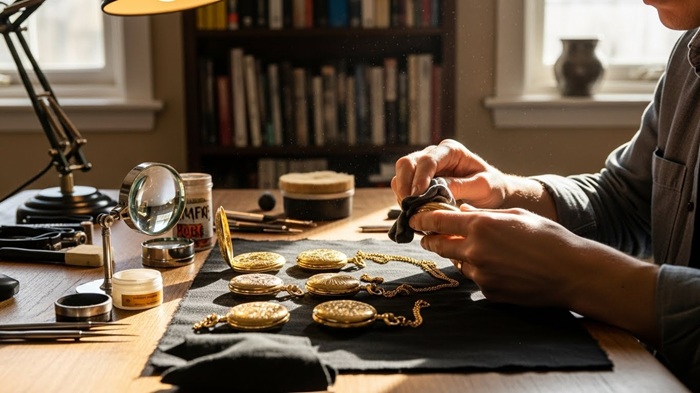
Can I Use Silver Polish On Gold Pocket Watches to Clean Them?
If you’ve recently unearthed a cardinal pocket watch, a great northern pocket watch, or even a delicate pocket watch, a 1980 Geneva 17 jewels cleaning and maintenance project from your drawer, the urge to make it shine again is understandable.
But before you reach for that bottle of silver polish—stop. Breathe. Put it down gently. Your gold pocket watch will thank you.
Gold and silver may often sit peacefully together in jewelry boxes, but when it comes to chemical cleaners, they’re very different creatures.
Silver polishes typically contain mild abrasives and sulfur-targeting agents designed to remove tarnish from sterling silver.
Gold, however—especially the soft, high-karat gold used in antique pocket watches—doesn’t tarnish in the same way.
What this means: silver polish can over-polish gold, abrade details, or leave a cloudy, uneven sheen.
If you try using silver polish to polish gold pocket watch cases, you’re effectively giving that gold surface a gentle sanding—something you definitely don’t want on engraved monograms, engine-turned patterns, or hallmark stamps.
A gold pocket watch isn’t something you want to “recreate”; you want the original finish preserved.
This warning is even more important for collectors of brands like Rosskot, which often feature plated or thin-gold-layered cases. One aggressive polishing session can go from “vintage charm” to “mysteriously patchy metal.”
So, what’s the best way to polish an old pocket watch by hand?
Glad you asked. The safest path is always the gentlest:
- Use a microfiber cloth—clean, dry, soft.
- If needed, apply a gold-safe, ammonia-free watch case cleaner.
- Move in slow, circular motions.
- Never polish near or on the dial, hinges, or crown without disassembly.
- For stubborn grime, consult a professional watchmaker.
- Absolutely no mechanical buffing unless you’re an expert.
Many collectors ask if they can use toothpaste as a home remedy. While it’s a classic DIY trick for stainless steel, using toothpaste on gold is about as wise as using sandpaper on a souffle—abrasive, unpredictable, and capable of ruining the texture permanently.
When dealing with mixed-metal timepieces, such as when you’re looking for the best way to polish a small silver and gold pocket watch, you must treat both metals according to their needs.
The safest approach is: clean, don’t polish aggressively; preserve, don’t “improve.” A light wipe-down and a proper gold-safe cream for polishing gold jewelry and watches is all most luxury watches need.
When in doubt, keep in mind that less is more. Pocket watches are tiny mechanical biographies; every scratch, engraving, and patina spot tells a story.
Over-polishing—especially with the wrong product—erases decades of history in minutes. As part of regular pocket watch 1980 Geneva 17 jewels cleaning and maintenance, gentle handling matters more than shine.
So no, don’t use silver polish on gold pocket watches. Keep the polish for the silverware, the toothpaste for your teeth, and your beautiful vintage timepiece for the next generation.
Related FAQs
Where do you oil a Rosskopf pocket watch?
Rosskopf pocket watches—whether early 1910 versions or later 2010 reproductions—follow the same basic lubrication points as simple pin-lever (Roskopf) movements. Oil only the balance staff pivots, the escape wheel pivots, the center wheel arbor, and the pallet pins sparingly.
These watches were designed as low-cost, low-maintenance movements, so over-oiling causes far more harm than under-oiling. Avoid applying oil to the mainspring or gear teeth directly. If unsure, have the movement cleaned and lubricated professionally.
How to keep an old pocket watch from tarnishing?
To prevent tarnishing, store the pocket watch in a low-humidity environment, ideally in a soft-lined case or pouch. Avoid skin oils—wipe the case with a microfiber cloth after handling. Add silica gel packs to storage boxes to minimize moisture.
Keep the watch away from perfume, polishing compounds, and household chemicals. For gold or gold-filled cases, tarnish is minimal, but fingerprints can dull the surface. Clean gently, avoid abrasive polishes, and service the case periodically.
Can you lubricate old pocket watches yourself at home?
Technically, yes, but practically—it’s risky. Old pocket watches require proper disassembly, ultrasonic cleaning, correct oils, and microscopic control of application. Applying oil without cleaning only traps dirt and accelerates wear.
Using the wrong lubricant or over-oiling can damage pivots, jewels, and balance amplitude. Without the right tools (loupe, oiler, movement holder, blower), you’re mostly guessing. Light external lubrication (e.g., pendant tube) is fine, but full movement lubrication is best left to a trained watchmaker.
The Conclusion
Although servicing an antique pocket watch can be expensive, your watch parts should be deep cleaned every two to three years by reliable watchmakers, mechanics, or jewelry shops so that they remain in proper working condition.
If you are an expert and know the process, using an ultrasonic cleaner to clean your antique pocket watch parts is an efficient and safe method for removing dirt and grime from delicate components.
